

You Can’t Plan for One Future Anymore
By Eileen Lawless
Storytelling is one of the oldest ways we make sense of the world. In social impact work, we use stories to explain what we have done and what we hope to build next. Perhaps that is why storytelling resonates so deeply with us as humans; stories are not just how we memorialize the past, they are how we carry possibility forward.
What is harder, and often more uncomfortable, is holding more than one possible future in mind at the same time. Many of us first encountered that idea in those “choose your own adventure” books, where the story changed depending on the choices made along the way. Real life is less tidy, and you can't exactly ask your funders and donors to choose their own adventure, but the underlying idea is similar. More than one future can be plausible at once.
Across different fields, people have developed ways of working intentionally with multiple futures, for a variety of reasons.
In finance, thinking in scenarios is standard practice. Stress testing and modeling different conditions are built into decision-making because the assumption is simple: the future will shift, and leaders need to be ready for more than one outcome.
In public policy and international development, futures thinking has increasingly been formalized as strategic foresight. The OECD has written extensively about anticipatory governance and the value of testing policies against multiple long-term scenarios. The United Nations Development Programme has invested in foresight approaches to help teams navigate complex and rapidly changing environments. UK, Australian, US, and other development agencies have used structured approaches to possible futures as a way to reassess assumptions and adapt as contexts evolve. Philanthropic institutions such as the Rockefeller Foundation have also shared scenario-based work that explores how global systems might unfold in different directions.
Many domestic nonprofits have used similar approaches, even if they did not label it “futures thinking.” During COVID and other crisis periods, organizations across the United States mapped best-, worst-, and middle-case scenarios to assess funding stability, staffing implications, and program continuity. At the same time, U.S.-based nonprofit think tanks such as the Institute for the Future have long focused on helping organizations anticipate alternative pathways and emerging shifts.
In social change spaces, practitioners such as Adam Kahane and REOS Partners have used scenarios in a different but related way. The purpose is not only planning. It is helping people working on difficult problems to imagine futures they may not yet agree on, or may not even believe are possible. The value lies as much in the shared thinking as in the scenarios themselves.
What strikes me across all of these traditions is that the goal is rarely prediction. It is preparation, perspective, and possibility.
The real value of working with multiple futures is not just better plans, but better decisions that emerge when people across titles and silos make time to think together and imagine what might be possible.
No single person, regardless of title, sees the whole landscape. Thinking in multiple futures works best when different perspectives are in the room. Leaders bring essential insight, but so do people closer to implementation, partners outside the organization, and those who experience the work differently. Making space for that collective thinking is not always easy, especially when time and funding feel tight. Yet teams that pause to think together often move faster and with greater clarity later.
This kind of thinking also does something else. Strategic plans and outcomes frameworks ask us to focus on what is actionable, which is necessary and important. But when we only allow ourselves to imagine futures that fit neatly inside current plans, we may narrow our sense of what change could look like. Even brief moments of exploring multiple futures can widen the aperture, helping teams see risks more clearly and possibilities more fully.
Facilitating this kind of shared futures thinking is one of my favorite types of work. I get to help organizations bring people across titles and silos into the room to explore multiple futures together and turn that thinking into clearer decisions. In the process, teams often rediscover a sense of possibility, realizing that the future is not just a table of outcomes to deliver, but a field of possibilities still open to influence.
And perhaps that is the real invitation here. The future is not a story we simply inherit. It is one we continue to write together.
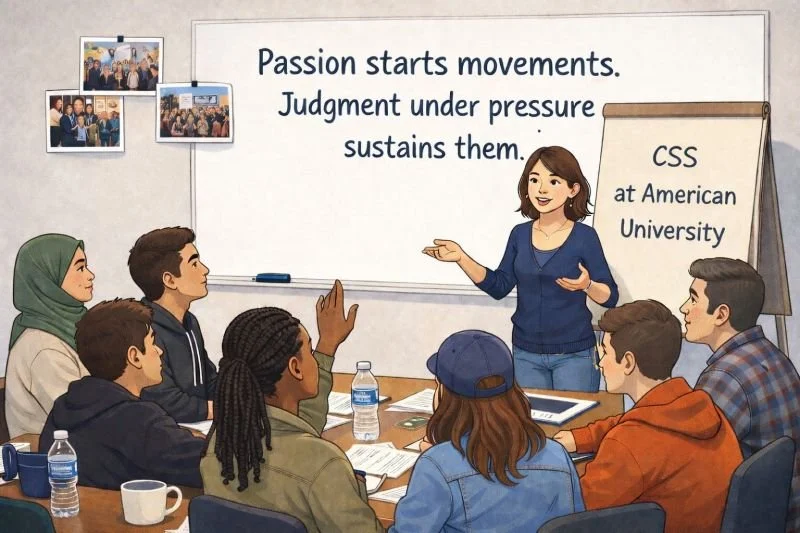
Decision Lab at American University’s Center for Leadership and Community Engagement
Decision Lab at American University
We walked into American University not knowing exactly what to expect.
We walked out impressed.
Two sessions. Two dozen students. A case study on Occupy Wall Street from 2011. One deceptively simple question: when the thing that defined your movement is taken away overnight, what do you do next?
They did not freeze. They oriented. They prepared. They positioned. They acted. And then they defended their decisions in 60 seconds to a room full of people who made completely different calls from different positions in the same ecosystem.
That is the work. Understanding that where you sit shapes what you see and how you respond. That passion starts movements but judgment sustains them. That these are learnable skills.
This felt like proof of something. The next generation of civic leaders is ready for complexity and systems thinking.
We just have to give them the tools.
#CivicLeadership #SocialMovements #DecisionLab #AmericanUniversity #CivicSafeguardStrategies
From Strategic Signals to Steady Footing Practicing Coherence in an Unstable Environment
By Eileen Lawless. Originally published on Substack
Jarvis Williams’ recent essay, When Strategy Signals Instability, offers a careful account of a dynamic many in the nonprofit and philanthropic sectors are already experiencing. His framing of institutions as signal generators, and his focus on the relationship between mission, strategy, and operational decisions, helps explain why organizations adapting in reasonable ways can still appear inconsistent.
This is a useful contribution. It names a pattern that is often felt but not well articulated. When signals from philanthropic institutions become harder to interpret, planning becomes more difficult, partnerships more tentative, and coordination can weaken. Over time, this raises questions not only about effectiveness, but about credibility and the basis of institutional authority.
Across organizations I have worked with, this has at times taken the form of shifting guidance from funders over short periods, encouragement to expand programming in response to demand, followed by requests to narrow scope due to emerging risks. Each decision is reasonable on its own. Taken together, they can leave organizations uncertain about direction.
Williams is careful not to attribute this to poor leadership or lack of discipline. He situates it within broader pressures. Philanthropic institutions are responding to changing political conditions, increased scrutiny, and urgent social demands. From the inside, decisions may feel pragmatic. From the outside, they can appear to shift direction in ways that are difficult to reconcile.
This helps explain how instability can emerge even when actors are acting in good faith.
At the same time, philanthropic signaling sits within a wider environment where nonprofit organizations are also managing instability. Many are navigating changing policy conditions, heightened regulatory and reputational risk, and increasing demand for services. Recent executive actions have added further uncertainty for some, particularly in how they assess compliance and public positioning. Instability in this context is layered rather than episodic.
This matters because it changes how the role of philanthropy is understood. In more stable conditions, inconsistent signals from funders would be one source of disruption. In the current environment, philanthropic behavior becomes more consequential. It is one of the few variables in the system that can be shaped intentionally. The question is not only how philanthropic institutions avoid contributing to instability, but how they might help reduce it.
Williams points to strategic coherence as a stabilizing force. Coherence allows signals to be interpreted with greater confidence, even as conditions change, helping partner organizations understand how decisions are made and how priorities evolve.
The challenge is that coherence cannot be assumed. It must be produced under the same conditions that make it difficult to sustain.
As conditions become more complex or constrained, a similar pattern appears across organizations. External conditions shift, information is incomplete, and decisions must be made under pressure. Organizations respond by looking outward for clarity, tracking signals and adjusting accordingly. This is reasonable, but it has unintended effects. When too much attention is directed outward, internal coherence can weaken. Different parts of the organization respond to different signals, and decisions are made without a shared frame of reference. Over time, organizations can reproduce the instability they are trying to navigate.
I have seen this play out repeatedly in high-pressure contexts. Program teams adapt to changing needs, communications teams grow more cautious about how work is described publicly, and leadership revisits strategy in response to funding signals. Each adjustment is grounded in sound judgment. Without a shared frame, they can move in different directions and send contradictory signals internally and externally.
Externally, this can erode trust with the communities these organizations serve. As communications become more cautious, references to specific groups or issues may be softened or removed, sometimes for valid safety or risk reasons. When those shifts are not clearly explained, communities may experience them as a loss of clarity or commitment, even when the underlying work remains unchanged.
When conditions are harder to read, the first task is not better prediction but stronger orientation. What is changing, what is not, what matters now, and where can we act? From there, teams hold core commitments steady and make deliberate choices about where to adapt.
I have seen this done well in practice. In one organization operating under significant political and legal pressure over the past year, this took the form of maintaining a clear commitment to its core service model while adapting around it. As funding shifted, scrutiny increased, and legal challenges emerged, leadership stayed focused on demonstrating the effectiveness of its methodological approach, while adjusting geographic scope and external engagement. That clarity about what would not change allowed the organization to absorb shocks without losing direction or morale.
In another setting, leaders within an umbrella organization supporting a network of affiliated nonprofits have taken on the role of helping their affiliates distinguish between what requires a response and what does not. As guidance, policies, and external signals shift rapidly, the pressure to react to everything can be high. Creating shared clarity about what requires action, what warrants monitoring, and what can be set aside has helped those organizations stay focused on their mission without overextending limited capacity.
This demonstrates that coherence can be practiced. It is expressed through patterns of decision making that are legible over time and reinforced by clarity about what will change and what will not. It becomes visible in how organizations communicate shifts in priorities, sequence actions, and explain their reasoning.
This applies to both nonprofit organizations and philanthropic institutions.
For nonprofits, the task is to maintain internal clarity while adapting to external pressure. This means limiting simultaneous adjustments, aligning on assumptions before responding publicly, and being deliberate about what not to change.
For philanthropic institutions, the task is to keep adaptations understandable to partners. This does not mean slowing down. It means making changes in ways partners can follow and explaining what is shifting and why.
In both cases, the goal is not to create fixed conditions. It is to act with consistency and clarity as conditions change.
Stability in the sector is shaped through interaction and relationships. When organizations share a clearer understanding of the environment, communicate more directly about constraints and tradeoffs, and establish a common view of how they will navigate pressure, they reduce uncertainty for one another and reinforce trust. This does not eliminate risk or disagreement. It makes coordination more possible.
The capacity to remain steady is not a role assigned to one part of the system. It is a discipline that must be practiced across it. The current moment places that discipline under strain, but also makes it more necessary. When instability comes from many directions, acting with coherence becomes one of the few stabilizing forces institutions can control.
Williams’ essay makes clear that inconsistent signals can weaken trust and coordination over time. The corollary is that coherent practice can strengthen both.
The environment is unlikely to settle anytime soon. Political, legal, regulatory, and funding conditions will continue to shift. The question is how philanthropic institutions and nonprofits choose to operate within that reality. Clarity does not arrive once uncertainty fades. It is established, maintained, and communicated while uncertainty is still present. That work is shared across the system.
#NonprofitLeadership #Philanthropy #CivilSociety #OperatingUnderPressure #OrganizationalResilience
Resilient Fundraising Seminar Success
90+ participants. 90 minutes.
A webinar filled with strategies and shared experience on building more resilient fundraising in uncertain conditions. The opening poll we ran told its own story: most participants are juggling 2–3 roles at once while some others have simply stopped counting.
No silver bullets. Just practical approaches, tested assumptions, and honest discussion about what’s shifting and how to stay steady regardless.
Great to facilitate the Resilient Fundraising Strategies webinar yesterday alongside PartnersGlobal in a strong collaboration grounded in practice, with Eileen Lawless, Bridget O'Loughlin, Luis Gómez Chow, Laura McKechnie, and Kellie Burk. Thanks also to Roselie Vasquez-Yetter who joined us and opened the session!
Looking forward to continuing the conversation.
Stay tuned for more details on upcoming workshops and events.
#NonprofitLeadership, #FundraisingStrategy, #Philanthropy, #NonprofitSector, #CivilSociety, #OperatingUnderPressure
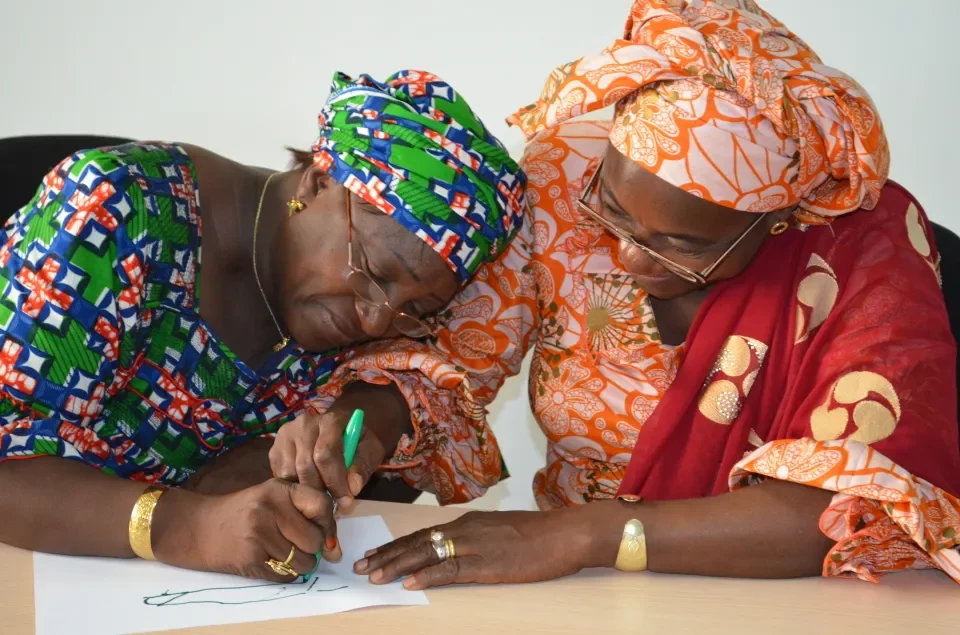
What Holds When Pressure Builds
Eileen Lawless and Bridget O’Loughlin on Lessons from Global Nonprofits. Originally published on Substack.
Nonprofit organizations in the United States are facing increased scrutiny, rhetorical attacks, legal and regulatory shifts, and shrinking budgets,threatening their crucial role in our democracy. For many, the uncertainty of the current environment has had achilling effect on activities. While this context may feel unprecedented for many US-based organizations, similar dynamics have played out in other settings, and are now becoming relevant in new ways in the United States. As former USAID foreign service officers and program implementers, we have spent decades supporting nonprofits in countries where civic space—the freedom people have to take part in public life—closes quickly. In this article we offer reflections as practical insights for organizations navigating similar pressures in the United States today.
This moment calls for deep sector-level thinking about civil society reform, but also a focus on the organizational level—how leaders and teams make decisions under pressure and prepare themselves to operate effectively in uncertainty.
Of course, for many organizations in the United States, especially those founded by and serving BIPOC communities, LGBTQ+ communities, and Muslim communities, operating under heightened scrutiny or constraint is nothing new. They have been navigating these realities for years, and there is much to learn from their experience and leadership.
In the following sections we offer lessons drawn from patterns we have seen repeatedly when organizations operate in environments marked by uncertainty, scrutiny, pressure, or rapid change.
First, Find Your Footing
When the external environment shifts quickly, the instinct for many leaders and teams is to respond quickly. However, in our experience, organizations under pressure benefit from intentionally creating space to understand what has really changed before deciding how to respond.
In Serbia, in 2020 government officials increased scrutiny of nonprofit organizations working on media and human rights issues, conductingarbitrary financial audits and promotingnegative public narratives that cast suspicion on their work. In response, USAID and PartnersGlobal (hereafter “we”) worked alongside organizations to help them pause and find their internal footing. Together, we developed practical tools to prepare for potential audits and external scrutiny. We also promoted greater coordination among the sector, helping them improve their collective readiness to respond to government pressure. The 37 organizations placed on a government blacklist responded thoughtfully and with a unified voice, denouncing government harassment disguised as legitimate oversight. In the end, due to local and international media pressure, the government did not follow through with the audits, and the organizations continued their work. They were also better prepared when, five years later, the government followed through on similar threats and raided the offices of some civil society groups.
In Cambodia, growing uncertainty around potentialgovernment restrictions on foreign funding in the Law on Associations and Non-Governmental Organizations, introduced in 2015, created a fragile operating environment for nonprofits. The situation exposed a structural vulnerability within the sector, as many organizations had become highly dependent on foreign donor support, and authorities used this vulnerability to control their activities. In response, we collaborated with organizations to take the time to reflect on these risks, explore ways to diversify their revenue streams, and strengthen their financial resilience. As a result of that space and clarity, some identified new sources of income; others adjusted their operating models to reduce reliance on a single revenue stream. Ultimately, organizations that took the time to target exactly where to invest their energy on proactive improvements were better equipped to continue serving their communities.
These examples demonstrate that organizations that make intentional space to find their footing early preserve more room to maneuver later.
Decide Together, Act Together
When pressure and uncertainty builds, it is common for leaders, boards, and operations teams to interpret the situation differently. When this happens, people within the same organization are effectively working from different assumptions, and even the best strategies can falter in execution. When operating under uncertainty, organizations are more effective if they create a shared understanding about priorities, risks, and roles.
In Senegal, the COVID-19 pandemic led to a sharp decline in nonprofits’ ability to operate. The government issued a series of emergency orders and decrees that effectively criminalized civic participation, and in the coming years, civic actors, especially activists and journalists, would face brutal reprisals for exercising their rights. In this context, many nonprofit leaders, particularly those working on culturally or politically sensitive issues, chose to shield their staff from external risks by centralizing decision-making and limiting internal information-sharing about organizational strategy and risks. While well-intentioned, this strategy made it more difficult for staff to adapt their activities in response to shifts in the operating environment and fostered discontent and disconnection. We worked alongside leadership teams as they prioritized structured, whole-team conversations that created space for information-sharing, reflection, and alignment. Teams unified their understanding of shifts in civic space, improved communications channels, and aligned on roles, expectations, and decision-making responsibilities. Coordination improved and teams developed a stronger sense of belonging while better supporting and understanding leadership decisions.
Organizations where leaders, board members, and staff make decisions together from a shared understanding of their changing environment tend to steady themselves by adjusting without losing internal cohesion, which leads to better results.
Protect Trust While Adapting
Under pressure, organizations often need to adapt their operations. The challenge is doing so without losing the trust of the communities, partners, and stakeholders they serve.
In Zimbabwe, in 2022 government authorities promotedaggressive anti-nonprofit narratives that began to take hold in the public discourse. Civil society leaders often responded defensively, using jargony language that mirrored Western, donor-centric narratives about closing civic space. Unfortunately, this language reinforced government narratives about civil society and heightened community suspicions. We worked with several organizations to deconstruct and analyze public narratives about nonprofits and civic engagement, identifying language that builds trust and, conversely, may fuel fear and division. The organizations then used these insights to clarify how they communicated their purpose, re-working their mission and vision statements to include language that was simpler and more aligned with constituent priorities. We also facilitated exchanges with peers in former Soviet countries who had navigated similar patterns of pressure. In the end, organizations remained grounded in their mission while better navigating a more constrained and politically sensitive environment.
In 2020, the Guatemalan congress enacted Decree 4-2020, which, among other measures, gave the government the power to arbitrarily rescind the legal status of nonprofits. In Guatemala, the operating environment is marked by social tension and strained institutional relationships, making it difficult for pro-democracy actors to maintain trust across divides. In response, we partnered with local civic leaders to invest in coalition-building and collaborative advocacy. The process encouraged and empowered diverse actors to align around shared and consistent messaging about the Decree and prioritize relationships with each other, even when disagreements were sharp. While the law remains in effect, organizations are more unified and have built broader public support for their work.
In sum, by protecting trust as they resist government pressure, organizations can preserve the relationships central to their missions.
Where This Leaves Us
The examples cited from our experiences are not offered as models to copy, but as practitioner reflections from work we have done alongside organizations making decisions under pressure. Across these experiences, we have seen recurring traits in how leaders and teams steady themselves, make choices, and protect their ability to serve their communities. The specifics differ from place to place, but the underlying choices are often surprisingly similar.
For US nonprofits, these lessons are not abstract or distant. Many organizations are navigating shifts in funding, increased scrutiny, and a more polarized operating environment. The patterns we have seen of what works in other contexts are not prescriptions, but they do offer practical ways to steady leadership, strengthen decision-making, and protect trust under pressure. We are all still learning how to do this. We would welcome reflections on how others are navigating pressure from increasingly repressive governments.
Eileen Lawless is the Chief of Programs and Engagement at Civic Safeguard Strategies, where she focuses on helping nonprofits navigate pressure, strengthen decision-making, and sustain their ability to serve their communities. She is a senior international and community development leader with more than 20 years of experience with USAID, international NGOs, and the United Nations, advancing democracy, human rights, and good governance across the Middle East and North Africa, Southern Africa, the Balkans, Timor-Leste, and Azerbaijan.
Bridget O’Loughlin is the Director of Partnerships and Ecosystem at PartnersGlobal, where she focuses on strengthening the global ecosystem of civic actors advancing peacebuilding, democracy, and human rights. She has 15 years of experience supporting civil society around the globe to navigate complex and increasingly constrained civic space, with a particular focus on Latin America.
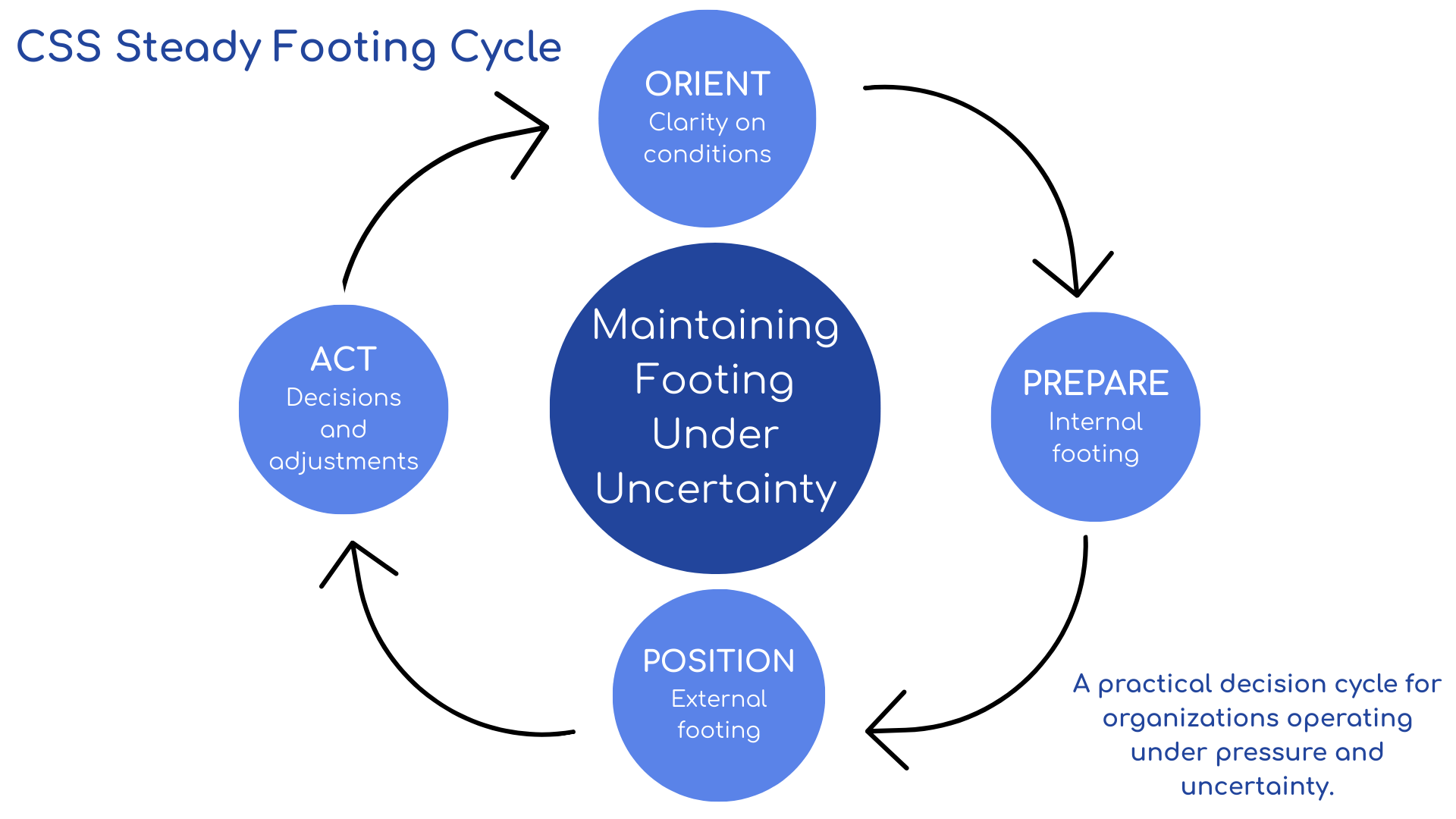
The Steady Footing Cycle: A Practical Guide to Leading Through Uncertainty
The Steady Footing Cycle
Over the past year, one theme has come up again and again in conversations with nonprofit, university, and civic leaders: decisions feel harder, conditions less predictable, funding tighter, and the margin for error smaller.
Organizations are not just looking for reassurance. They are asking for practical tools to help them operate effectively when conditions shift and traditional planning cycles are no longer enough.
In response, Civic Safeguard Strategies, all women-owned, has developed a set of applied learning modules focused on preparedness, decision-making, and organizational practice under uncertainty.
The modules are organized around a practical decision model we call the Steady Footing Cycle:
Orient.
Prepare.
Position.
Act.
Reorient as conditions change.
Together, the modules form an applied learning architecture that translates the Steady Footing Cycle into practical exercises and decision practices leaders and teams can apply immediately in nonprofit, policy, and civic leadership environments.
This approach is practical, adaptable, and grounded in real operating conditions. It is not a one-size-fits-all model. Each module can stand alone or be sequenced into a broader learning experience designed to strengthen clarity, credibility, and preparedness when conditions are uncertain.
These tools are now ready for delivery.
We are looking forward to working with universities, associations, foundations, and nonprofit teams exploring practical ways to navigate uncertainty and make decisions with clarity.
We are a practice shaped by global and domestic experience, evolving alongside the civic actors and institutions we work with and believe in.
If your organization or program is working through similar questions about preparedness, decision-making, or operating under uncertainty, we would welcome the conversation, whether your organization is women owned or now.
#CivicSafeguardStrategies #NonprofitLeadership #HigherEdLeadership #PublicPolicy #DecisionMaking
Happy International Women’s Day from CSS
Building a new business is no mean feat.
Pivoting from careers we loved, and that defined us for many years, is not easy either.
This year we are doing both.
What makes the journey extraordinary is that we are doing it together. The four of us are building something new while inspiring, challenging, and lifting one another up along the way. Having partners who bring different experiences, perspectives, and strengths makes the work stronger and the path forward far more meaningful.
We are also grateful for the many women who surround and support us. Colleagues, mentors, friends, mothers, and mothers in law who have been inspiring, and whose leadership and encouragement continue to shape the work we do.
As Estée Lauder once said, “I never dreamed about success. I worked for it.”
Today we celebrate the women who build, lead, and support one another along the way.
#InternationalWomensDay #WomenFounders #WomenInLeadership #WomenSupportingWomen #CivicLeadership #NonprofitLeadership
Back to the Classroom: Why We’re Leveling Up at CSS
After the closure of USAID in 2025, I found myself asking a difficult question: what comes next?
When the opportunity to join Civic Safeguard Strategies (CSS) arose, I had to reimagine myself, not just as a strategist or leader shaped by years in government service, but as a consultant and small business owner.
Some roles felt familiar: relationship builder, strategic analyst, project manager. Those muscles were well developed. But others – financial manager, systems operator, and yes, salesperson – were new and, at times, daunting.
Starting a small business is both exhilarating and overwhelming. That’s why, after earning an entrepreneurial certificate last year, CSS enrolled in Arlington Economic Development’s BizLaunch program this year.
It’s been energizing to be in a classroom, to meet founders from across industries and hear about their journeys. From jewelry makers to healthcare providers to tech innovators, the entrepreneurial spirit in our community is inspiring.
The BizLaunch sessions on marketing plans and financial projections have sharpened our strategic thinking and business discipline. And last week’s session on AI was especially enlightening not only for time-saving tools, but also for thinking critically about how emerging technologies can strengthen our advisory services and help nonprofits make more informed decisions amidst uncertainty.
Upskilling isn’t just about professional growth, it’s about showing up better for the clients we serve.
Sincere thanks to Arlington Economic Development for investing in small businesses like ours. We’re proud to be building CSS to serve Arlington County, the DMV, and beyond, and excited about what comes next.
#LevelingUp #BizLaunch #CivicSafeguardStrategies #NonprofitConsulting
Operating Under Pressure: Strategies for Modern Civic Leaders
We are hearing from many civic and nonprofit organizations that feel like they are operating inside a pressure cooker right now.
Inside Philanthropy recently described *fear* as a defining trend shaping philanthropy and civil society in 2025. Leaders are navigating polarization, heavy reliance on a few major funders, regulatory scrutiny, and burnout. The margin for error feels thin.
For many organizations, this is not abstract. It shows up in board conversations, funding discussions, public scrutiny, and everyday decisions. The rules keep shifting. It is exhausting.
This is also when fear starts to quietly shape judgment. Not as panic, but as constraint. Options narrow. Risk tolerance changes. Decisions get more cautious.
At Civic Safeguard Strategies, this is where our work starts.
We help nonprofit and civic organizations and their funders operate well when conditions are uncertain or constrained. Our focus is practical preparedness, decision clarity, and governance under pressure.
Our team brings field tested experience from complex civic and governance environments where institutions, civil society groups, and funders had to function under real operational and political strain. That work requires steadiness and sound judgment.
We work with leadership and operations teams when strategy, risk, governance, reputation, and funding realities are all in play at the same time. We help teams anticipate risk, make clear choices, and adapt without losing credibility or mission focus.
We are a practice grounded advisory and facilitation team focused on operating readiness under pressure. We work alongside teams in real time, strengthening decision making and operating discipline when the path forward is not obvious.
If your organization or foundation feels under strain, we can help create the space needed for clarity and steady action, even in the most uncertain times.
#NonprofitLeadership #Governance #Philanthropy #Operations #RiskAwareness #CivilSociety #Preparedness
UCONN Seminars on U.S. and Overseas Experiences
Last week @UCONN School of Public Policy in Hartford and Stamford, the Civic Safeguard Strategies team led a timely discussion on how global trends related to civic space offer useful orientation for the current U.S. nonprofit landscape.
We explored the reality that shifts in political rhetoric and policy can translate into real operational constraints for organizations. This is a pattern we have seen repeatedly across international contexts. Identifying these risk dynamics early, however, is only the first step.
The core of our session focused on the pivot: supporting organizations to move from a reactive state of uncertainty to a strong, grounded footing. By strengthening financial viability, scenario thinking, adaptive planning and management, and strategic communications, nonprofits can be ready and able to continue delivering on their mission with confidence, even as conditions change rapidly.
#UConnSPP #NonprofitLeadership #Operations #DecisionMaking #RiskManagement #CivilSociety #Philanthropy
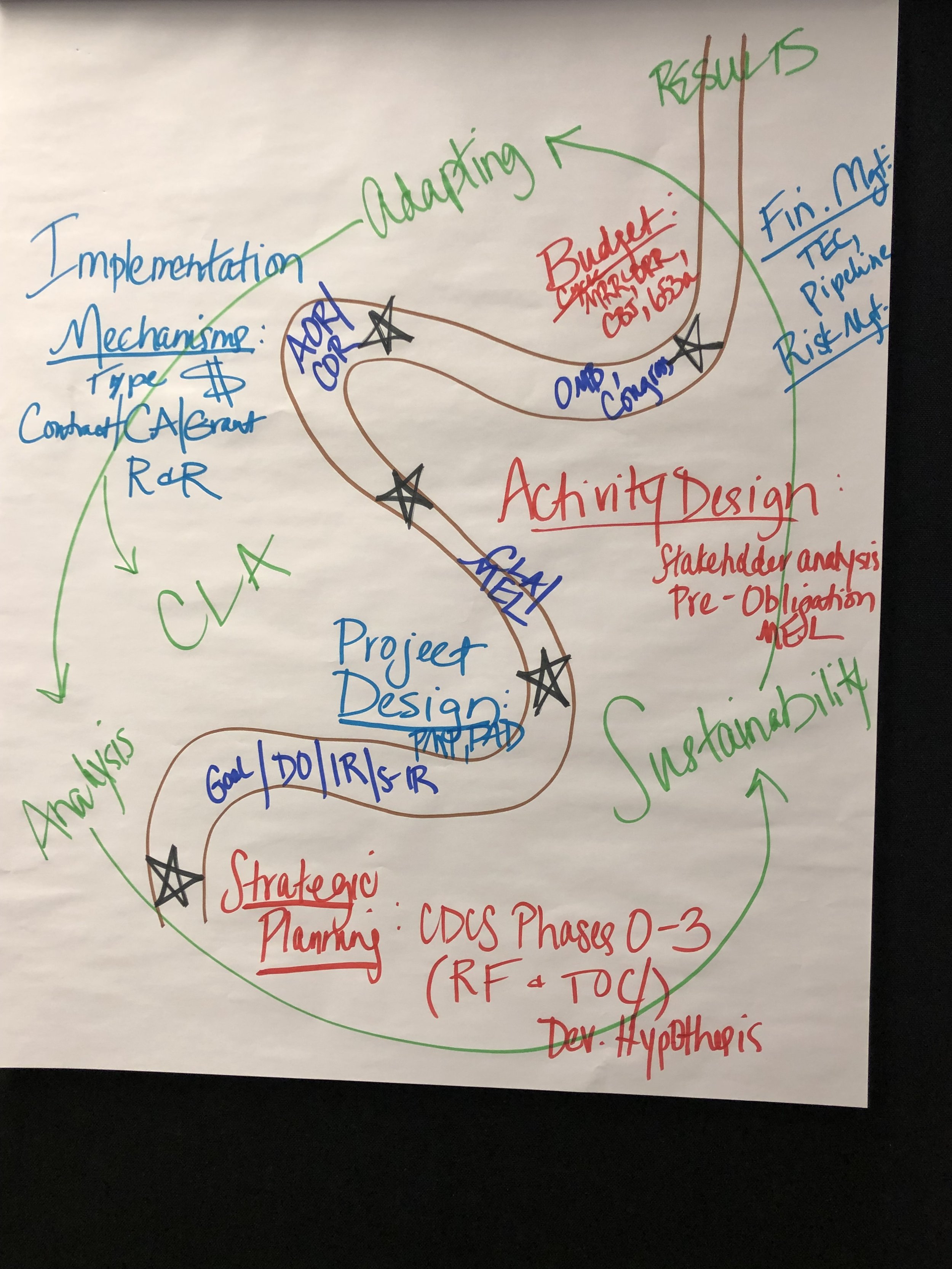
More than Fundraising
More than Fundraising
When you think of fundraising, what are the first words that come to mind? Revenue generation? Absolutely! Diversification? You bet! Annual Gala? Yay, fancy!
What about transparency and accountability? Crisis communications? Legal and regulatory environment? If you answered no to any of the last three, your fundraising strategy is missing key areas. The truth is, effective fundraising requires more than just donor cultivation, moves management principles and pipelines. Effective fundraising requires strong internal controls and transparency and accountability to ensure that existing and potential new donors feel confident that their contributions are being properly spent. It requires having a ‘ready to activate playbook’ on how your organization will communicate during rapidly changing circumstances. It requires a deep understanding of the legal and regulatory environment to protect your organization's tax exempt status, to ensure proper handling of donations and to protect from it from baseless investigations.
Effective fundraising requires a holistic, organization-wide approach. Failure to address these key areas of resilience could, at best, leave potential funding on the table. At worst, it could result in critical vulnerabilities and has the potential to undermine your entire organization's work.
Let’s work together to strengthen your organization.
To learn more, check out our website at Civic Safeguard Strategies (CSS) and complete an intake form for nonprofits or foundations to get the conversation started: https://lnkd.in/e56-fUAg
We’ve navigated the hardest environments before; let us navigate this new one with you.